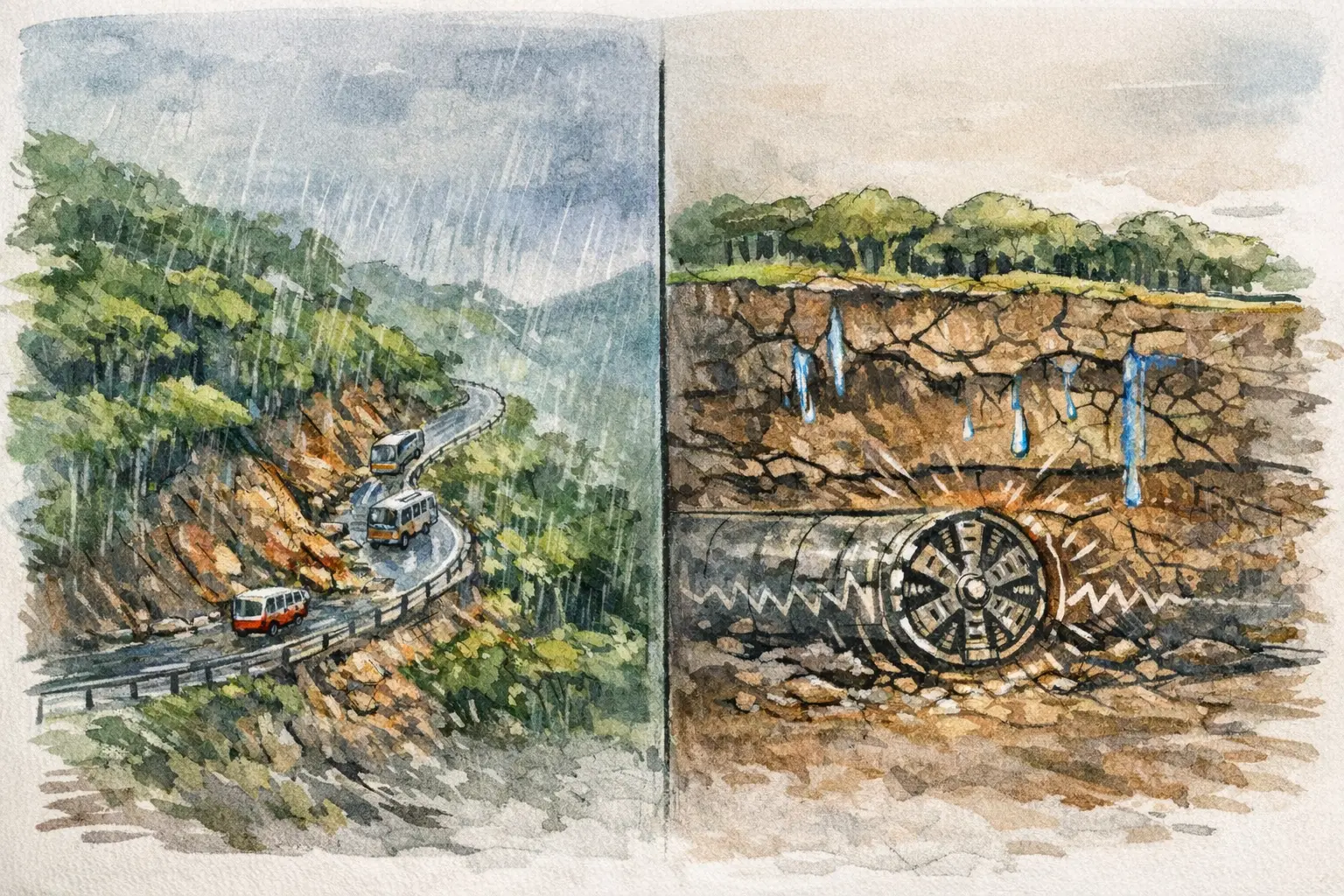
Agumbe, often hailed as the Cherrapunji of the South, is not merely a scenic route connecting the plains to the coast; it is a complex, living respiratory system of the Western Ghats. Nestled within its dense canopy lies a delicate ecological balance that dictates the climate pattern for much of South India. However, this serenity is currently under siege by a polarized debate: the proposal for a tunnel bypass versus the demand for widening the existing ghat road. Proponents argue that these projects are essential for faster connectivity to Manipal’s medical hubs and for commercial logistics. Yet, when we strip away the emotional arguments and analyze the situation through the lens of geological science and environmental engineering, a startling truth emerges: both the tunnel and the road widening are not solutions, but invitations to a catastrophic disaster.
Let us first dismantle the argument for road widening. To the untrained eye, shaving off a few meters from the hillside to expand the tarmac seems like a straightforward civil engineering task. However, the geology of Agumbe is unforgiving. The ghat consists of steep gradients composed largely of laterite soil and loose rocks, held together almost entirely by the root systems of the ancient shola forests. Widening the road requires "toe cutting"—removing the base support of the hill. In a region that receives over 7,000 mm of rainfall annually, cutting the toe of a slope is akin to removing the bottom card of a house of cards. The stability of the entire hillside is compromised, turning the road itself into a potential landslide zone.
The machinery used for such expansion poses another silent threat. The heavy vibrations from JCBs and rock breakers loosen the soil structure deep within the slopes. While the road might look stable immediately after construction, the monsoon acts as a catalyst. Water seeps into these vibration-induced micro-cracks, increasing pore water pressure, and eventually leading to massive slope failures. We have witnessed this exact phenomenon in the Shiradi and Charmadi ghats, where unscientific widening has resulted in perennial landslides, blocking the very connectivity these projects aimed to improve.
Furthermore, the calculation of tree loss for widening is often grossly underestimated. It is not just about the number of trunks cut; it is about the destruction of a natural anchoring system. The roots of Agumbe’s trees act as biological soil nails, gripping the earth and preventing erosion. Replacing this intricate, millions-of-years-old bio-engineering with concrete retaining walls is a fool's errand. Concrete walls act as dams, blocking the natural subsurface flow of water. When the hydrostatic pressure builds up behind these walls during a heavy downpour, they burst, triggering landslides that are far more destructive than natural soil erosion.
Now, consider the second, more ambitious proposal: the tunnel. Touted as a modern engineering marvel that bypasses the winding curves, the tunnel is presented as the ultimate solution. However, tunneling through the Western Ghats is fundamentally different from tunneling through the solid granite of the European Alps. The rock strata here are heterogeneous—a chaotic mix of hard rock, soft clay, and water-charged aquifers. Using Tunnel Boring Machines (TBMs) or drilling-and-blasting methods in such mixed geology is fraught with danger. The vibrations from tunneling travel upwards, destabilizing the soil layers above, which support the pristine Someshwara Wildlife Sanctuary.
The most critical oversight in the tunnel proposal is the management of "muck" or excavated debris. A tunnel of this magnitude would generate millions of tons of rock and soil waste. In the ecologically sensitive zone of Agumbe, there is simply no safe place to dump this debris. Dumping it in the valleys, as is often done illegally, chokes the natural streams and alters the course of rivers. This leads to artificial floods downstream during the monsoons and severe water scarcity during the summers. The environmental cost of this debris management is rarely factored into the glossy project reports presented to the public.
Economically, the tunnel project is a bottomless pit. The estimated cost runs into thousands of crores, a figure that inevitably balloons due to the geological surprises that the Western Ghats throw up during construction. Is it prudent to spend such an astronomical amount of public money to save perhaps thirty to forty minutes of travel time? When we weigh this against the irreversible ecological damage—the loss of biodiversity, the drying up of streams, and the permanent scarring of the landscape—the return on investment is not just negative; it is devastating.
We must also consider the "induced demand" that comes with such infrastructure. A wider road or a tunnel does not just accommodate existing traffic; it invites more. It opens the floodgates for heavy multi-axle trucks and unchecked tourism, turning a biodiversity hotspot into a noisy, pollution-filled transit corridor. The delicate micro-climate of Agumbe, which supports the King Cobra and countless endemic species, cannot survive the heat islands created by heavy vehicular exhaust and asphalt accumulation.
The argument often falls back on "emergency medical access." While this is a valid concern, building a massive tunnel is a sledgehammer approach to crack a nut. We are trying to solve a healthcare logistics problem with a heavy infrastructure solution, which is inherently flawed. Creating a corridor that risks collapsing the mountain itself does not guarantee safety; it creates new hazards for the very ambulances trying to pass through.
The frequency of extreme weather events due to climate change further weakens the case for heavy intervention. We are seeing cloud bursts and high-intensity rainfall becoming the new normal. In such a volatile climate, tampering with the natural slope stability is reckless. The mountains of Agumbe have stood for eons because they have reached a natural equilibrium. Disturbing this equilibrium with dynamite and concrete is an act of arrogance that nature will eventually correct, often violently.
This does not mean we abandon the need for better connectivity or safety. It means we must abandon the archaic notion that "conquering" nature is the only way to build infrastructure. The choice between a tunnel and road widening is a false dichotomy; both lead to the same destination—ecological ruin. We need to look beyond these two destructive options and explore how modern technology can help us coexist with the ghats rather than carve through them.
In the subsequent articles of this series, we will delve deeper into the specific impacts on water security, analyze the failures of similar projects like the Atal Tunnel, and finally, present a concrete, tech-driven alternative that saves both the environment and lives. The path forward for Agumbe lies not in heavy machinery, but in smart engineering and sustainable planning.
Also Read
❤️ What is Matter? The Future of Smart Home Compatibility
❤️ Building Olympians: How Science and Discipline Are Shaping Karnataka’s Future Shooters
❤️ THE DRAGON'S CODE: INSIDE CHINA'S TECH SUPERPOWER AMBITIONS
❤️ Maximizing Battery Health: The Ultimate Guide for iPhone & Android in 2026
❤️ Treatment for Bengaluru's Traffic Woes: India's First Hi-Tech Center Launches
🟢 Follow our WhatsApp Channel for continuous updates JOIN ➤
🛒 Shop Online

No Comment Yet.
Stay informed with breaking news, trending stories, and in-depth analysis.