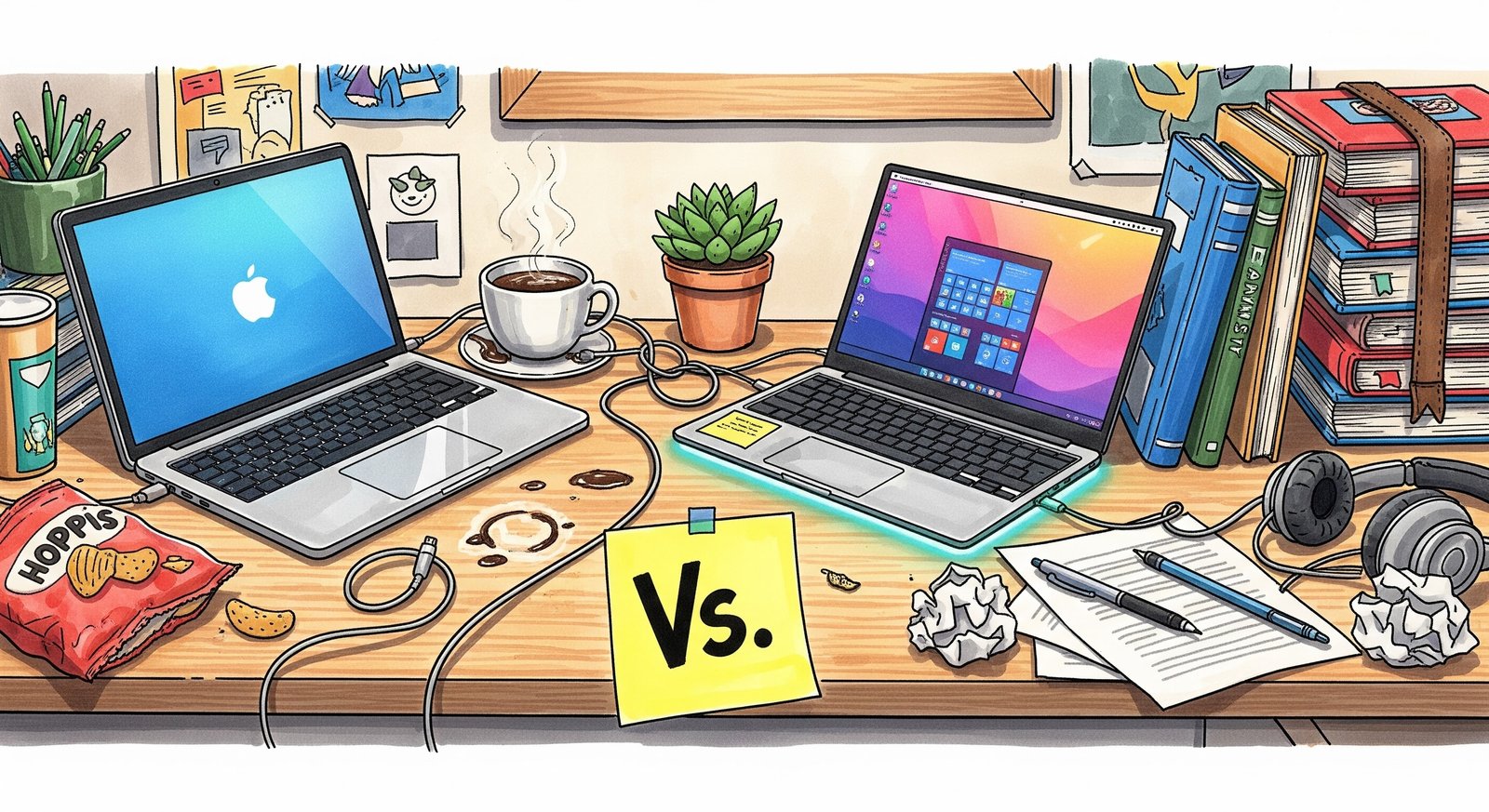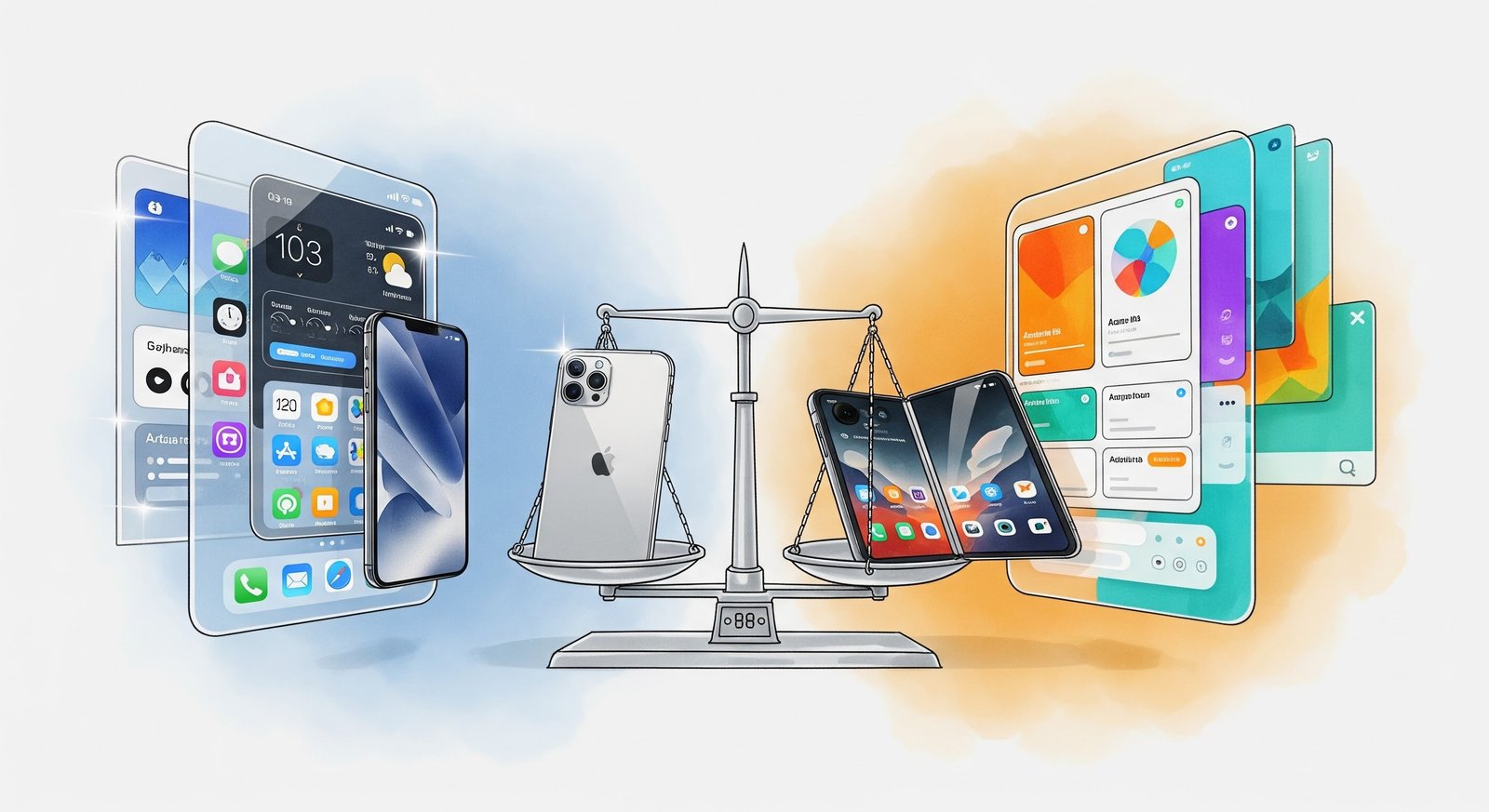
For over fifteen years, the smartphone world has been divided into two distinct camps: Team iPhone and Team Android. In the United States, this choice has evolved from a simple tech preference into a defining cultural identifier. As we settle into 2026, the landscape looks different than it did just a few years ago. The gap between the two platforms has narrowed significantly in terms of hardware, yet the philosophical and ecosystem differences remain as stark as ever.
If you are standing in a carrier store or browsing online, wondering which device to commit to for the next few years, the decision is more complex than ever. It is no longer just about the phone in your pocket; it is about the AI assistant that manages your life, the mixed-reality headset you might buy, and how you communicate with your family. This comprehensive guide will strip away the marketing hype and look at the real-world factors that should drive your decision in 2026.
The Social Dilemma: The Post-RCS Era:
For a decade, the "Blue vs. Green Bubble" debate was the primary driver of iPhone sales among younger demographics in the US. Apple's iMessage used blue bubbles for Apple-to-Apple chats and green for SMS to Android, which often resulted in broken group chats and blurry videos.
In 2026, we are now fully in the "Post-RCS" era. Last year, Apple finally adopted Rich Communication Services (RCS). This means that today, when an Android user texts an iPhone user, high-quality photos and videos are shared seamlessly, and typing indicators work across platforms. The functional friction is largely gone.
However, the social stigma has proven harder to erase. The bubbles are still green. In 2026, the distinction has shifted from "broken chats" to "ecosystem signaling." While you can now send a crystal-clear video of your vacation to your iPhone-using friends from your Samsung device, you are still visually marked as an "outsider" in the chat interface. For many US consumers, the convenience of fitting into the "blue bubble" aesthetic remains a powerful psychological draw, even if the technical barriers have fallen. If your entire circle uses FaceTime and iMessage apps, choosing Android still means choosing a slightly different digital existence.
User Interface: Spatial Design vs. Adaptive Freedom
The core philosophy of the iPhone operating system, iOS, continues to be simplicity and consistency. By 2026, iOS has embraced more "Spatial Design" elements, borrowing heavily from the interface of the Vision Pro headset. The icons have depth, and the system feels fluid and alive. Apple controls both the hardware and the software, resulting in a user experience that is incredibly polished. If you pick up an iPhone today, it works almost exactly like the iPhone you might have had five years ago, but faster and smoother.
The philosophy here is still "It just works." You do not need to tinker with settings to get good battery life or smooth performance. For users who view their phone as a tool that should simply disappear into the background and do its job, iOS remains the superior choice.
On the other hand, Android in 2026 has doubled down on being "Adaptive." Whether you buy a Samsung, a Pixel, or a Motorola, the software adapts to the hardware. This is essential because Android hardware is now incredibly diverse. Android allows for a level of multitasking that the iPhone still struggles to match.
With the maturity of Android 16, customization has reached new heights. You can use AI to generate entire interface themes on the fly. If you want to place your app icons in a circle, or have widgets that change based on the weather and your location automatically, you can. Android is for the user who wants to "own" their computing experience, offering a file management system that acts like a real computer.
The Ecosystem Lock-in: Beyond the Walled Garden
When you buy a smartphone in 2026, you are buying an entry ticket into an ecosystem. Apple is the master of the "Walled Garden," and the walls have only gotten higher.
The integration between Apple devices is now seamless to the point of being invisible. If you have an iPhone, a MacBook, and an Apple Watch, they act as a single organism. You can copy text on your phone and paste it onto your laptop instantly. Your AirPods switch automatically to whichever device you are looking at. With the rise of affordable versions of the Apple Vision headset, the iPhone has become a primary controller and content source for spatial computing.
This integration creates a "lock-in" effect. Once you have invested in the watch, the earbuds, and the spatial computer, switching to Android becomes expensive and painful. You would have to replace not just your phone, but potentially your entire digital life infrastructure.
Android's ecosystem, however, has become the "Bridge Builder." In 2026, Android's integration with Windows 12 is phenomenal. If you use a PC for work, an Android phone is a much better companion. You can stream apps from your phone to your PC, share clipboards, and transfer files wirelessly with a drag-and-drop simplicity that rivals Apple's AirDrop.
Furthermore, Android accessories are universal. A pair of high-end Sony earbuds works perfectly with a Pixel phone, a Windows laptop, or an iPad. A Garmin smartwatch connects equally well to any Android device. If you prefer the freedom to mix and match brands—using a Dell laptop, a Bose headset, and a Samsung phone—the Android ecosystem supports that freedom.
Hardware Innovation: The Foldable Norm
Apple tends to be conservative with hardware changes. In 2026, the iPhone is still largely a refinement of the glass rectangle concept. While rumors of a folding iPhone persist, the current lineup focuses on perfection of the traditional form factor—thinner bezels, brighter screens, and indestructible titanium frames.
The Android world is where the form factor revolution has fully taken hold. In 2026, foldable phones are no longer niche experiments; they are mainstream flagship options. Devices like the latest Galaxy Z Fold or Pixel Fold offer a tablet-sized screen that fits in your pocket, which is a game-changer for productivity and media consumption. Flip-style phones have become the standard choice for fashion-forward users who want a compact device.
If you want hardware that transforms, zooms 100x to capture the moon, or charges fully in under 15 minutes, Android is still the home of these aggressive innovations. Apple, lacking internal competition for iOS devices, moves at its own steady, deliberate pace.
Privacy and Security in the AI Age
For a long time, Apple used privacy as its main marketing weapon. While Apple still champions on-device processing, the rise of advanced AI has complicated the narrative. In 2026, both Google and Apple rely heavily on "Private Cloud" infrastructure to process complex AI requests that your phone's chip cannot handle.
Apple's "Private Cloud Compute" ensures that your data is encrypted even from Apple when it leaves your phone. For the privacy-absolutist, the iPhone remains the gold standard because the business model is hardware sales, not advertising.
However, Android has introduced robust privacy dashboards that are now standard. You can see exactly which AI agent accessed your personal context and revoke that access instantly. Google has also introduced "Sandbox" technologies to limit how much advertisers can learn about you. Moreover, Android's open nature allows security-conscious users to install specialized firewalls and privacy tools that are simply not allowed on iOS.
Security is effectively a tie in 2026. While iPhones are generally less prone to malware due to the closed App Store, Google Play Protect now uses real-time AI scanning to catch threats before they install. As long as you stick to official stores, both platforms are incredibly secure.
The Financial Angle: Price and Resale Value
This remains a critical consideration for US buyers. iPhones are expensive, but they are an asset. An iPhone retains its value better than almost any other consumer electronic device. You can buy a flagship iPhone for $1100 today and likely trade it in for $700 two years from now. The secondary market is huge and liquid.
Android phones, unfortunately, still depreciate faster, though the gap is closing for top-tier models. A high-end Samsung device might lose 45% of its value in one year. However, this depreciation can be a benefit if you are a bargain hunter. You can often buy a "like new" refurbished Android flagship from last year for a fraction of its original price.
Additionally, carrier deals in the US continue to distort pricing. AT&T, Verizon, and T-Mobile frequently offer "free" iPhones or Androids if you sign a 36-month contract. These deals often make the upfront cost irrelevant, shifting the focus back to which operating system you prefer.
Software Longevity: The Seven-Year Standard
Historically, Apple dominated software support. But in 2026, the major Android players have matched and even codified this. Google and Samsung now strictly adhere to their seven-year update promises. This means a phone bought in 2026 is guaranteed to receive the latest Android OS until 2033.
This is a massive shift from the early 2020s. It means that buying an Android phone is no longer a short-term commitment. You can hand that phone down to a child or sell it with the assurance that it is still secure and up-to-date. While Apple still has a better track record of delivering these updates to all users on day one (avoiding the "staggered rollout" of Android), the longevity gap is effectively closed.
Voice Assistants: The Battle of Agents
2026 is the year of the "AI Agent." The old voice assistants that could only set timers are dead. Apple's Siri, powered by Apple Intelligence, has become a contextual genius within your personal data. It knows what is on your screen, it can search through your emails to find a reservation, and it can perform actions across apps. However, it is often limited by Apple's strict privacy guardrails.
Google's Gemini, integrated deeply into Android, is a powerhouse of knowledge and action. It acts as a true secretary. It can hold a conversation with a customer service rep for you, summarize lengthy documents, and generate complex content. In 2026, Google's AI feels "smarter" in a general knowledge sense, while Apple's AI feels more "personal" and woven into the device.
Conclusion: Making the Choice in 2026
So, which ecosystem should you choose in 2026?
Choose the iPhone if:
You value a consistent, polished experience that prioritizes privacy.
You are already invested in the Apple ecosystem (Mac, iPad, Vision Pro).
You want the highest resale value for your device.
You prefer an AI assistant that works quietly on-device rather than in the cloud.
Most of your social circle uses iMessage and FaceTime.
Choose Android if:
You want the latest hardware form factors like foldables.
You prefer a computer-like experience with true file management.
You use a Windows PC and want seamless integration.
You want the most powerful, cloud-connected AI assistant available.
You value the freedom to install any app from any source and customize your interface completely.
Ultimately, there is no bad choice in 2026. Both iOS and Android have matured into exceptional platforms. The "best" phone is no longer about which one is faster—they are both incredibly fast. It is about which digital philosophy fits the life you have built. Whether you choose the walled garden of Apple or the open bridge of Android, you are getting a piece of technology that continues to redefine how we live.

No Comment Yet.
Stay informed with breaking news, trending stories, and in-depth analysis.