| Nagaraj Vaidya
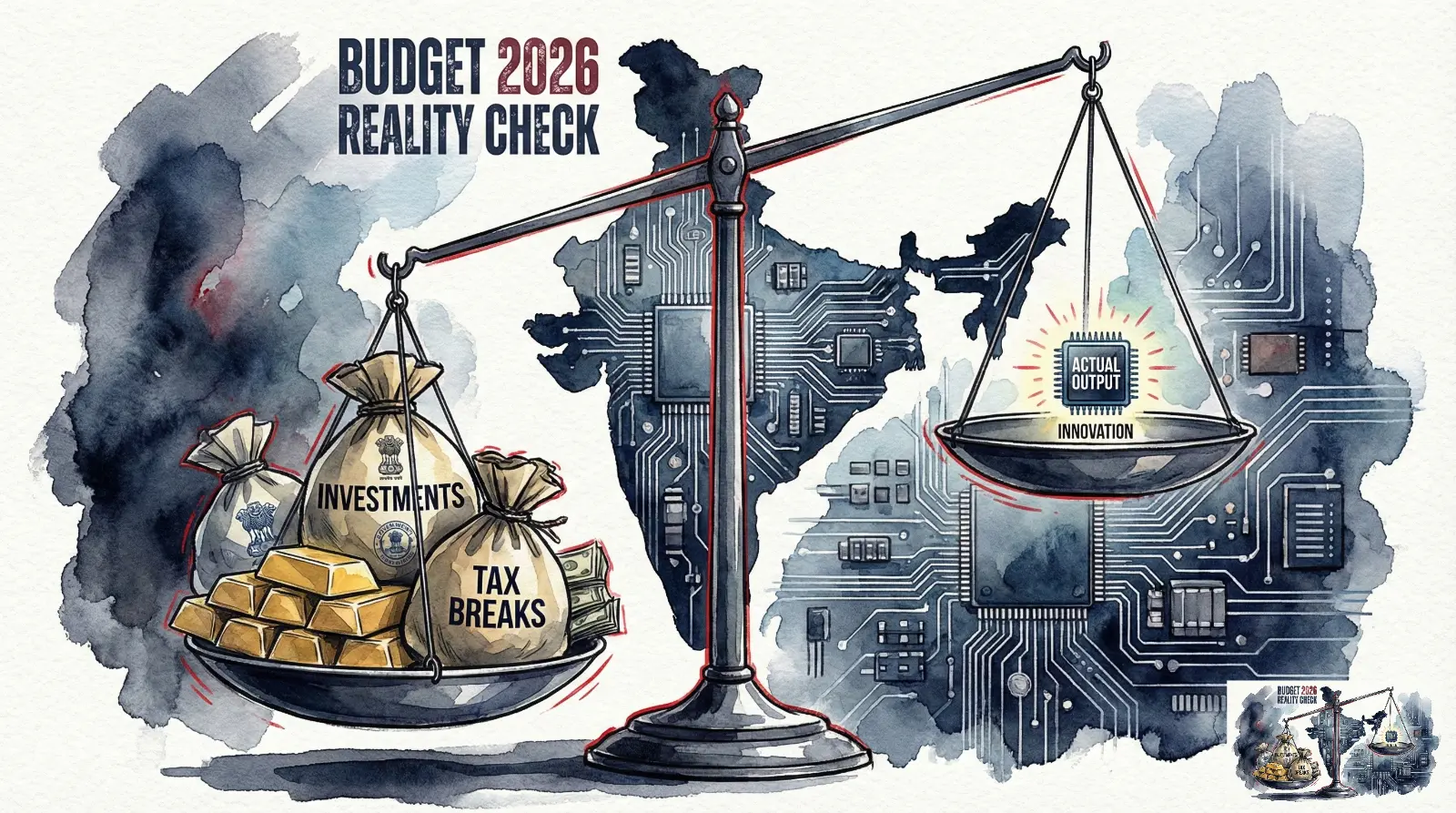
The Union Budget 2026-27, presented by Finance Minister Nirmala Sitharaman, appears on the surface to be a windfall for the technology sector. However, hidden within the fine print are several harsh realities and daunting challenges. The government's pivot from 'assembling' to 'manufacturing' and from 'services' to 'products' is a welcome strategic shift, but the execution path is riddled with obstacles. Under the India Semiconductor Mission 2.0 (ISM 2.0), the focus has moved to producing chip-making equipment and raw materials. Yet, globally, giants like Taiwan and China are decades ahead in this race. Merely pouring money or drafting policies cannot make India self-reliant in chip design overnight. The government's push for Indian IP (Intellectual Property) is directionally correct, but it is ironic that the fundamental research mindset required for this is still largely absent from our education system.
The massive ₹40,000 crore allocation for the Scheme for Electronics Components Manufacturing serves as a wake-up call that we must move beyond "screwdriver technology" in mobile phone manufacturing. Until now, we have been importing foreign components, assembling them here, and labeling it 'Make in India'. Now, the government seems adamant about manufacturing basic components like resistors and capacitors domestically. But the million-dollar question remains: Are our local manufacturers equipped to withstand the onslaught of cheap component competition from China? While the reduction in customs duties on parts for household items like microwave ovens may please consumers, it risks stifling domestic component manufacturers in the long run.
The government's move regarding Critical Minerals is strategically significant. The plan to establish Rare Earth Corridors in Odisha, Kerala, Andhra Pradesh, and Tamil Nadu acts as fuel for future technology. However, the success of this initiative hangs on how the government balances mining with environmental conservation. Customs duty exemptions on capital goods required for processing Lithium and Cobalt will help reduce EV battery costs, but an EV revolution cannot happen through duty cuts alone; the parallel challenge of charging infrastructure remains unaddressed.
Tax reforms in the IT sector give with one hand and take with the other. Bringing software development, KPO, etc., under a single umbrella with a 15.5% Safe Harbour margin and raising the limit to ₹2,000 crore is a boon for mid-sized companies. However, the stance on Data Centers is debatable. Granting a tax holiday until 2047 to foreign companies providing cloud services globally using Indian data centers feels like rolling out the red carpet for foreign giants. From the perspective of India's data sovereignty, is it right to appease foreign corporations to this extent? Doubts persist about whether domestic data center companies will get a level playing field.
The government's enthusiasm for AI and emerging technologies needs a reality check. The talk of bringing AI to agriculture through 'Bharat-VISTAAR' sounds impressive. But in villages where basic internet connectivity is still patchy, how useful will AI chatbots really be to a farmer? Instead of imposing technology, it is crucial to ensure technology complements grassroots solutions. Similarly, while the plan to establish AVGC Labs in 15,000 schools is being hailed as revolutionary, in a scenario where government schools lack basic infrastructure, high-tech labs risk becoming mere decorative items. The budget is silent on where the skilled trainers required to teach animation and gaming will come from. Hardware without software and human resources risks becoming nothing more than e-waste.
The decision to form a 'High-Powered Committee' to study the impact of AI on the job market seems like a delaying tactic. The fear of job losses due to AI is immediate and requires immediate solutions. By the time a committee is formed, submits a report, and actions are taken, millions of youth might have already lost their livelihoods. Instead of direct financial aid for reskilling engineers and professionals on a war footing, wasting time through committees reflects an old bureaucratic mindset ill-suited for the speed of the digital age.
For startups, this budget is a mixed bag of sweet and sour. Removing the ₹10 lakh value cap on courier exports has opened the global market for small exporters, which is a welcome move. However, the change in tax policy on Share Buybacks is a bitter pill for startup founders. Treating buybacks as capital gains rather than dividends, and taxing promoters at 22% to 30%, deals a blow to entrepreneurship. This will become a significant burden for investors and founders looking for an exit strategy.
Furthermore, increasing the investment limit for Persons Resident Outside India (PROI) from 10% to 24% could threaten the autonomy of domestic startups. While capital inflow might increase, it opens the door for foreign control over India's promising tech companies. 'Make in India' should not just mean manufacturing in India, but also retaining ownership and intellectual property rights in Indian hands. This policy risks handing over control of our future unicorns to foreign entities for the sake of easy money.
In the science and research sector, the ₹10,000 crore allocation for 'Biopharma SHAKTI' seems to prioritize economic gain over healthcare access. Manufacturing biologics for non-communicable diseases is the need of the hour, but focusing solely on production without ensuring price control and accessibility for the common man amounts to bowing down to the pharma lobby. On a positive note, the move to support 4 telescopes for astronomy shows a promising intent to foster a scientific temper.
The massive ₹20,000 crore allocation for 'Carbon Capture, Utilization, and Storage' (CCUS) under the guise of climate change and Green Tech is surprising, given that this technology is still in its infancy and prohibitively expensive globally. This raises suspicions that it might be an indirect subsidy to large polluting industries like cement, steel, and refineries. Encouraging the installation of expensive machinery to absorb pollution rather than preventing it at the source feels less like true green technology and more like a corporate-friendly 'greenwashing' strategy.
In tourism, the government has shown zeal in digitizing tourist destinations through the 'National Destination Digital Knowledge Grid'. But in reality, basic infrastructure at our major tourist spots is crumbling. Developing VR and apps without fixing fundamental issues like roads, toilets, and safety is akin to buying a smartphone for social media when there is no food at home. Policymakers must understand that physical problems cannot be masked by a digital veneer.
Digitization and automation of the Customs department might ease trade, but the agony traders already face with the GST portal due to technical glitches and server issues must not be repeated here. The goal of implementing a fully automated system within 2 years is ambitious, but given the history of government IT infrastructure, it seems far from easy.
Ultimately, this budget has taken a huge gamble on future technologies. It dreams of propelling India to the forefront of 'Deep Tech' sectors like semiconductors, AI, Space Tech, and Biopharma. However, for this dream to become reality, budget speeches are not enough. Effective implementation of announced schemes, corruption-free administration, and the creation of an open environment conducive to research are imperative. Otherwise, all these numbers risk remaining castles in the air. TechVaidya readers need to view this budget not just through the lens of tax benefits, but critically, as an attempt to shift the technological direction of the country.

No Comment Yet.
Stay informed with breaking news, trending stories, and in-depth analysis.