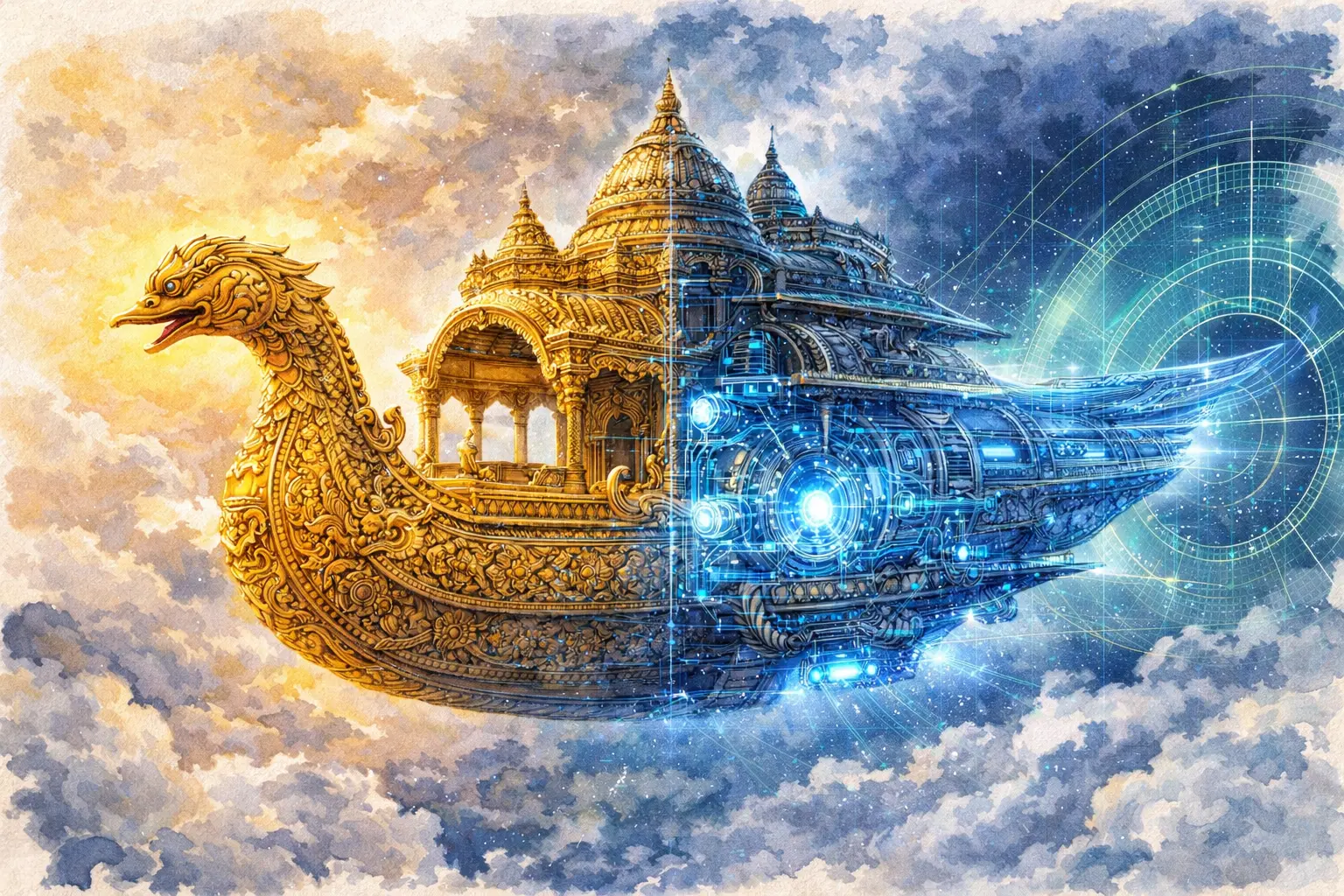
One of the most intriguing scenes from our childhood memories of watching the Ramayana series on television was undoubtedly Ravana’s Pushpaka Vimana. Watching that swan-shaped chariot floating majestically in the sky, it wasn’t uncommon for us to think, "Dad, wouldn’t it be amazing if our car could fly like that?" Back then, we dismissed it as mere magic or fantasy. It is common for modern scientists to brush off such descriptions in mythological tales as mere poetic imagination. However, when we look at our ancient texts not just as religious scriptures but through the lens of science, the information revealed is enough to startle even the most brilliant modern minds.
More Than Just a Chariot
The Pushpaka Vimana was not merely a flying chariot. If we observe the descriptions given in Valmiki’s Ramayana and other ancient Sanskrit texts, a suspicion arises that it possessed technology far more advanced than today’s state-of-the-art fighter jets or private luxury aircraft. There are descriptions that the Pushpaka Vimana traveled at the speed of the mind, could change its shape at will, and possessed an infinite seating capacity—no matter how many people boarded, there was always room for one more. When viewed through the prism of modern physics, fascinating truths begin to emerge.
The Science of Vaimanika Shastra
Maharshi Bharadwaja, one of ancient India’s great sages, penned a text titled Vaimanika Shastra (Science of Aeronautics). This text speaks extensively about aviation technology. It contains detailed information on how to manufacture aircraft, what metals to use, what fuel is required, and even what pilots should wear. It might be hard to believe that thousands of years before the Wright Brothers invented the airplane, our ancestors had mastered technology that defied gravity, but the formulas in Vaimanika Shastra suggest exactly that.
Advanced Metallurgy and Heat Shields
The Vaimanika Shastra mentions three specific types of metals for aircraft construction: Somaka, Soundalika, and Mourthvika. These are not your standard steel or aluminum. The text states that mixing these metals in specific proportions creates a robust alloy capable of withstanding 16 types of heat and remains unbreakable. This description bears a striking resemblance to the 'Heat Shield' technology used in modern rockets and spacecraft today. These metals were used to keep the aircraft cool when it heated up due to atmospheric friction.
The Mercury Vortex Engine
When it comes to fuel, the Pushpaka Vimana did not run on petrol or diesel. Ancient texts mention the use of 'Padasara' or Mercury. It is said that the aircraft flew using the energy generated when mercury was heated. Modern scientists refer to this concept as the 'Mercury Vortex Engine.' NASA and other space agencies are currently experimenting with 'Ion Engines.' A prevailing theory suggests that if a heavy liquid like mercury is spun at high speeds using an electromagnetic field, it can generate anti-gravity. It is highly probable that Ravana’s aircraft used this very technology to rise into the sky silently.
Mind Control and Neuralink
Another unique feature of the Pushpaka Vimana was that it moved according to the speed of the pilot's mind. Essentially, as soon as the pilot thought of a destination, the vehicle would turn in that direction. This might sound like an exaggeration. However, looking at today’s 'Brain-Computer Interface' (BCI) technology, it seems plausible. Chips like Elon Musk’s Neuralink have made it possible to control computers through human thought. In modern fighter jets, similar sensors are being integrated into pilot helmets. We can hypothesize that neuro-technology was at its peak during Ravana’s time, and the aircraft’s control system was directly linked to the pilot’s brain.
The Forgotten Pioneer: Shivkar Bapuji Talpade
We must not forget the name of the Marathi scholar Shivkar Bapuji Talpade in Indian history. It is said that in 1895—eight years before the Wright Brothers flew in 1903—Talpade flew an unmanned aircraft named 'Marutsakha' at Mumbai’s Chowpatty Beach. He used formulas from the Rigveda and Bharadwaja’s Vaimanika Shastra to build this aircraft. Unfortunately, he received no support from the British government, and his invention disappeared from the pages of history. Otherwise, the credit for inventing the airplane might have gone to India.
Stealth Technology in Ancient Times
Today’s advanced Stealth Fighters fly without being detected by radar. Surprisingly, Vaimanika Shastra has a chapter titled 'Goodha,' which explains how to make an aircraft invisible to the enemy. It mentions techniques using mirrors to reflect sunlight and smoke to cloak the vehicle. Ravana might have used such technology to evade Jatayu’s vision while abducting Sita. Furthermore, the texts mention machines like 'Paroksha' (to listen to enemy conversations inside their aircraft) and 'Dikpradarshana' (to change the direction of enemy planes). These parallel today’s radar, jammers, and wireless communication interception systems.

Where Did the Tech Go?
So, what happened to such advanced technology? Where did it go? It is possible that these technologies were destroyed in devastating wars like the Mahabharata, or the sages might have kept this knowledge secret to prevent misuse. Over time, scripts may have been lost, leaving only the stories behind. The texts we have today are likely just fragments of a massive repository of knowledge.
Some argue this was Alien or extraterrestrial technology. Carvings of helicopters, rockets, and astronauts in ancient temples stand as witnesses that aerial travel might have been common in those times. Ravana didn’t just have one Pushpaka Vimana; it is said he had several aircraft at his airports in Lanka, with a separate department to manage them.
Sustainable Future Tech
The name "Pushpaka" implies it was as beautiful and light as a flower. Yet, during war, it became as hard as a diamond. This can be compared to today’s 'Shape Shifting' materials. The US military is currently researching drones that can change shape in mid-air. This proves that there is science hidden behind every "magic" described in our Puranas.
Science and spirituality are two sides of the same coin. Tasks once done by Mantra power are now done by Machine power. While they piloted aircraft through mental concentration, we now drive them using sensors. Ravana’s arrogance may have destroyed him, but the technology and architecture of his empire remain a subject of research today.
We must not dismiss our history as mere fables but rather extract the scientific elements within them. NASA scientists are showing interest in learning Sanskrit because they have found it to be the most suitable language for computer programming. If we fail to utilize the treasure trove of knowledge left by our ancestors, we are betraying ourselves.
The Pushpaka Vimana was technically and eco-friendly far ahead of today’s aircraft. It caused no noise pollution and spewed no smoke. Developing such sustainable technology again is the challenge before today’s scientists. Ravana’s flying chariot is not just imagination; it is a prologue to future science. Let us remember the glory of our past to shape the technology of the future.


No Comment Yet.
Stay informed with breaking news, trending stories, and in-depth analysis.